Real Time Simulation System
- Home
- Industries

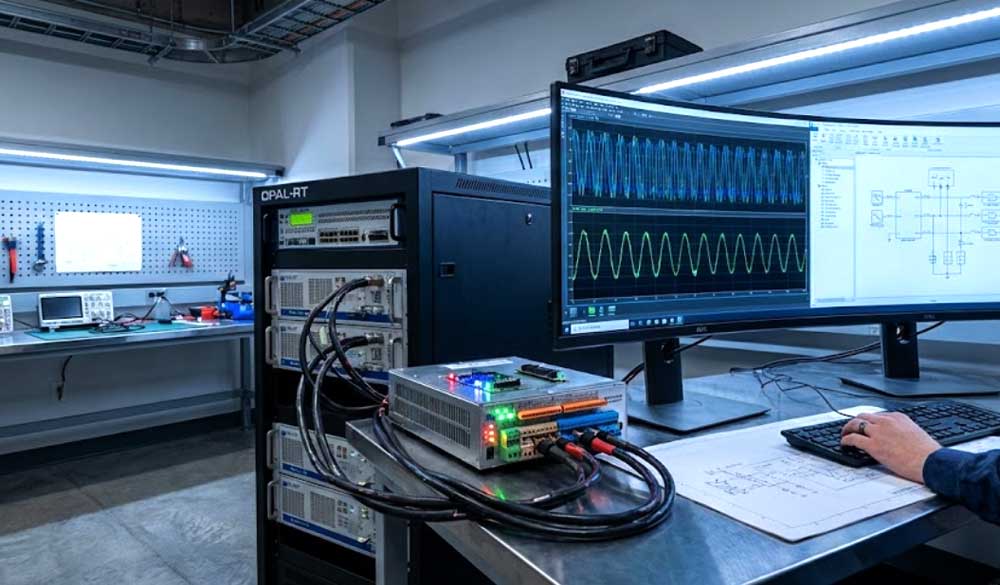
Real time simulation software and hardware solutions are becoming valuable engineering tools, making Real Time Simulation System in Bangladesh an important technology for testing, training, control development, and system performance analysis. A real time simulation system reproduces the behavior of an actual process or equipment within a controlled virtual environment while responding to inputs as they occur. Engineers can use the simulated model to study complex systems without exposing expensive or critical equipment to unnecessary risks.
A professional simulation platform can represent electrical networks, power systems, industrial processes, mechanical systems, automation equipment, transportation systems, and other dynamic applications. The system can connect mathematical models with controllers, sensors, communication interfaces, and operator interfaces to create a realistic testing environment.
For organizations in Bangladesh, this technology can improve engineering confidence before physical implementation. It can help identify design problems, evaluate control strategies, train operators, and verify system responses. Real time simulation is especially useful where physical testing is costly, difficult, or potentially unsafe.
Real time simulation technology uses computer hardware and software to calculate a system model at a controlled rate that corresponds with the behavior of the real application. Unlike conventional offline simulation, the model interacts continuously with external devices or control systems.
The simulator receives input signals, processes the mathematical model, and generates output signals within the required simulation cycle. This makes it possible to connect actual controllers, protection devices, measurement equipment, or operator interfaces to the simulated environment.
A real time simulation platform can support:
The quality of the final result depends on model accuracy, processor capability, input and output interfaces, timing performance, and the engineering method used to develop the simulation. Proper configuration is therefore essential for dependable results.
Hardware in the Loop simulation is one of the most useful applications of real time simulation. It allows a physical device or controller to interact with a simulated plant. The simulator represents the surrounding system while the actual hardware operates as it would in a real installation.
This approach allows engineers to test controllers before connecting them to expensive field equipment. It can also reproduce operating conditions that may be difficult to create safely in a physical environment.
HIL testing can be used for:
The simulator must provide accurate signals and maintain appropriate timing so that the hardware under test responds realistically. Engineers can introduce normal and abnormal operating conditions and observe how the physical device behaves.
Power systems are highly dynamic and require careful analysis before new equipment, protection schemes, or control strategies are implemented. Real time simulation provides a controlled environment for evaluating these systems.
A power system simulator can model generation, transmission, distribution, loads, transformers, converters, protection devices, and renewable energy sources. Engineers can examine system responses to switching events, faults, load changes, and control actions.
Power system simulation can support:
For Bangladesh, where the power sector continues to evolve, real time simulation can support engineering development and operational preparedness. It provides a practical way to study system behavior before implementing changes in a live electrical network.
Industrial plants contain interconnected processes that can be difficult to test directly. Real time simulation allows engineers to reproduce these processes virtually and evaluate control responses without interrupting actual production.
Process simulation can represent equipment such as pumps, valves, tanks, heat exchangers, compressors, boilers, and other industrial components. Control systems can then interact with the simulated process as though they were connected to an operating plant.
Applications include:
A realistic model should represent important process dynamics and operating constraints. Engineers can then test both normal operation and abnormal conditions. This improves understanding of system behavior and helps reduce commissioning risks.
Control systems are responsible for maintaining process variables within desired operating conditions. Errors in control logic can lead to instability, poor performance, equipment damage, or production interruptions. Real time simulation provides an effective environment for testing control algorithms before field deployment.
Engineers can connect programmable controllers, distributed control systems, industrial computers, and other control hardware to the simulator. The simulated plant responds to controller commands, allowing the complete control loop to be evaluated.
Control validation may include:
Testing in a simulated environment allows engineers to identify logic errors without placing production equipment at risk. It also helps shorten commissioning activities because many control functions can be checked before installation.
Real time simulation is also valuable for technical training. Operators can learn how a system behaves under normal and abnormal conditions without interacting with a live industrial process.
A training simulator can reproduce realistic operating scenarios and allow trainees to practice responses. Instructors can introduce faults, equipment failures, process disturbances, or emergency conditions and evaluate operator actions.
Training applications can include:
The major benefit is a safe learning environment. Operators can make mistakes during training without damaging actual equipment. Repeated practice can improve confidence, technical understanding, and response quality.
Testing only normal operating conditions is not sufficient for critical systems. Engineers also need to understand how equipment and controls behave during faults and unexpected events. Real time simulation makes it possible to reproduce such scenarios in a controlled environment.
Fault simulation can represent electrical faults, sensor failures, communication problems, equipment trips, control failures, abnormal loads, or process disturbances depending on the application.
Engineers can evaluate:
Controlled fault injection is valuable because some real failures cannot be safely reproduced on operational equipment. Simulation allows engineers to study these conditions without creating unnecessary hazards.
Real time simulation is closely related to digital twin technology. A digital twin represents a physical asset or process through a digital model that can use operational information to reflect actual behavior.
When combined with real time data, a simulation model can provide deeper insight into equipment performance and system condition. Engineers can compare expected behavior with observed behavior and investigate deviations.
Digital twin applications may include:
The value of a digital model depends on the quality of its underlying data and engineering assumptions. A poorly developed model can produce misleading conclusions. Therefore, model validation and continuous improvement are important parts of a reliable digital twin strategy.
Renewable energy systems can introduce variable operating conditions into electrical networks. Solar generation, wind generation, battery storage, and power electronic converters may respond differently from conventional equipment.
Real time simulation can help engineers study these technologies and their interaction with electrical networks. Controllers and inverters can be tested against changing conditions without exposing actual grid equipment to experimental scenarios.
Renewable energy simulation can support:
As renewable energy deployment grows, simulation can help engineers understand system interactions and develop appropriate control strategies.
Modern industrial systems rely on communication networks to exchange information between controllers, sensors, protection equipment, and supervisory systems. Communication problems can affect system performance even when individual devices are functioning correctly.
A real time simulation environment can reproduce communication conditions and test how automation systems respond. Engineers can evaluate communication delays, signal loss, incorrect data, or equipment interruptions under controlled conditions.
Testing may cover:
This type of testing is particularly useful before commissioning complex automation systems. Early identification of communication problems can reduce troubleshooting effort during field installation.
Research institutions and engineering organizations can use real time simulation to investigate new technologies and develop improved control methods. Researchers can test theoretical models against practical hardware behavior without constructing complete physical systems.
The platform can support experiments involving electrical engineering, mechanical systems, automation, energy management, robotics, transportation, and other technical fields.
Research activities may involve:
Real time simulation also supports repeatable experiments. Researchers can run similar scenarios under controlled conditions and compare different algorithms or system configurations.
The use of real time simulation can provide important technical and operational benefits for organizations in Bangladesh. Industrial facilities, universities, utilities, engineering companies, and research centers can use simulation to improve system understanding and reduce the risks associated with physical testing.
Major benefits include:
The technology can also support local engineering capability. Engineers can develop, test, and validate solutions within a controlled environment instead of depending entirely on field trials.
A successful real time simulation project requires careful planning. The simulator should be selected according to the required model complexity, simulation speed, I/O requirements, communication interfaces, and hardware under test.
System integration may involve computers, real time processors, analog and digital interfaces, communication modules, controllers, measurement devices, and visualization software. Each component must operate reliably as part of the complete test environment.
Important design considerations include:
Engineers should define the testing objective before selecting hardware and software. A clear specification reduces integration problems and ensures that the final system meets the intended application.
A real time simulator is only as useful as the model running inside it. Model development should therefore be treated as a major engineering task. The model must represent the important physical behavior of the system while remaining suitable for real time computation.
Model validation involves comparing simulation results with reliable reference information. Depending on the project, this may include laboratory measurements, manufacturer data, historical operating information, or results from established simulation tools.
A robust modeling process includes:
Validation should continue as the system evolves. Changes in equipment, control logic, or operating conditions may require updates to the model.
The future of Real Time Simulation System in Bangladesh is closely connected with industrial automation, smart grids, renewable energy, advanced manufacturing, digital twins, engineering education, and intelligent infrastructure. As systems become more interconnected, organizations need better methods for testing complex interactions before implementation.
Artificial intelligence and advanced data analytics can further improve simulation by supporting automated model calibration, anomaly detection, optimization, and scenario analysis. Cloud based engineering workflows may also make simulation resources more accessible to distributed technical teams.
Future applications may focus on:
Real Time Simulation System in Bangladesh can provide a strong foundation for safer engineering, better testing, and more efficient system development. By combining accurate models, real hardware, control systems, communication interfaces, and professional engineering practices, organizations can evaluate complex scenarios before applying changes to physical infrastructure. This improves technical confidence and supports reliable operation across industrial, energy, research, and infrastructure applications.