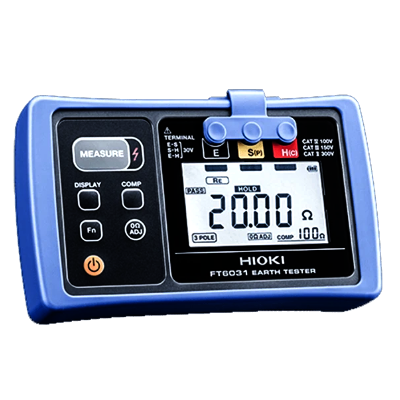
Amprobe GP-2A Ground Resistance Resistivity Tester
Professional Ground Resistance and Soil Resistivity Testing Made Practical


Amprobe GP-2A is a professional electrical testing instrument, and Amprobe GP-2A Ground Resistance Resistivity Tester Price in Bangladesh is a useful search term for engineers and technicians seeking reliable grounding and soil resistivity testing equipment. The instrument is designed to support electrical professionals in evaluating grounding systems and investigating soil conditions that influence grounding performance. Ground resistance and soil resistivity measurements are important during the installation, inspection, maintenance, and troubleshooting of grounding systems because they provide valuable information about the effectiveness of an earth electrode arrangement. The GP-2A can be useful for applications involving electrical installations, grounding networks, power distribution facilities, industrial plants, commercial buildings, and engineering projects where proper earthing performance is essential. Its professional design makes it suitable for field engineers, electrical contractors, maintenance technicians, testing laboratories, and commissioning teams. By providing a dedicated solution for grounding and resistivity assessment, the instrument helps professionals perform systematic electrical inspections and make informed decisions regarding grounding design, maintenance requirements, and installation quality.
Ground resistance testing is an essential part of electrical system commissioning and preventive maintenance. An effective grounding system provides a controlled path for fault currents and helps improve protection for electrical equipment and personnel. The Amprobe GP-2A is designed to assist professionals in assessing the resistance characteristics of grounding arrangements and determining whether an earth system is performing as expected. Regular testing can help identify deterioration caused by corrosion, loose connections, environmental changes, damaged conductors, or aging grounding components. The instrument can therefore be incorporated into inspection programs for electrical distribution systems, industrial equipment, transformers, generators, switchgear, communication installations, and other grounded systems. Its professional application makes it suitable for engineers who need dependable test equipment for evaluating grounding performance during installation and service activities. Ground resistance measurements can also provide useful reference information when troubleshooting unexpected electrical behavior or verifying the condition of an existing grounding network. Using dedicated test equipment allows maintenance personnel to approach grounding inspection systematically and support safer, more reliable electrical installations.
Soil resistivity is an important engineering parameter when designing and evaluating grounding systems. Different soil compositions can provide significantly different electrical resistance characteristics, which directly influence the performance and design of earth electrodes. The Amprobe GP-2A Ground Resistance Resistivity Tester can support professionals in assessing soil resistivity during grounding investigations and engineering projects. Soil testing is particularly useful before installing new grounding systems because the measurement results can help engineers understand local ground conditions and determine an appropriate grounding arrangement. This can be valuable for substations, industrial facilities, commercial developments, telecommunications sites, renewable energy installations, and other infrastructure projects requiring effective earthing. Environmental factors such as moisture, soil composition, temperature, and geological conditions can influence resistivity, making field assessment an important part of professional grounding design. By providing a dedicated method for resistivity investigation, the tester can help engineers collect practical information about site conditions and use that information when planning grounding electrodes, conductors, and related earthing infrastructure.
The GP-2A is suitable for a broad range of electrical engineering applications where grounding performance and earth conditions need to be evaluated. Electrical contractors can use dedicated grounding test equipment during installation and commissioning, while maintenance teams can use it during periodic inspection and troubleshooting. Engineering consultants may also require ground resistance and soil resistivity measurements when assessing the suitability of a proposed grounding arrangement. The instrument can be useful in industrial facilities, commercial buildings, utility installations, construction projects, power system infrastructure, and other locations where electrical safety depends on effective grounding. Grounding tests can help identify abnormal conditions and provide technical information for maintenance planning. The instrument can also complement other electrical testing equipment used for insulation, continuity, voltage, current, and power system assessment. Its dedicated functionality makes it a practical addition to a professional electrical testing toolkit. For organizations that perform regular electrical inspections, having suitable ground resistance and resistivity testing equipment can improve the consistency and efficiency of field assessment procedures.
A reliable grounding network requires periodic inspection because its electrical characteristics can change throughout the service life of an installation. Physical damage, corrosion, soil condition changes, construction activity, and connection deterioration can affect grounding performance. The Amprobe GP-2A can be used as part of a preventive maintenance program to help technicians evaluate grounding conditions and identify areas that may require further investigation. Regular measurements provide useful technical information that can be compared with previous test records to identify changes over time. This approach allows maintenance teams to monitor grounding performance rather than relying solely on visual inspection. During troubleshooting, ground resistance and resistivity testing can also provide useful information when investigating grounding related concerns or unexpected electrical behavior. The tester is therefore valuable for organizations that prioritize electrical reliability and systematic maintenance. By incorporating grounding measurements into scheduled inspection procedures, engineers can develop a more complete understanding of electrical infrastructure and make better informed decisions about corrective maintenance, grounding improvements, and long term system reliability.
Field engineers and electrical technicians often work in demanding environments where test equipment must be practical, dependable, and suitable for repeated use. The Amprobe GP-2A is designed for professional grounding and resistivity measurement applications and can be useful for engineers who conduct testing at different project locations. A dedicated tester allows technicians to focus on the specific electrical characteristics of grounding systems without relying on general purpose instruments alone. This is particularly valuable during commissioning, maintenance surveys, construction inspections, and grounding investigations. The instrument can support engineering teams working on both existing installations and new projects where grounding performance needs to be assessed. Its professional application makes it suitable for electrical contractors, facility maintenance departments, utility se
The Amprobe GP-2A Earth Ground Resistance Resistivity Tester is a valuable solution for professionals who require dedicated equipment for evaluating grounding systems and soil conditions. Ground resistance and soil resistivity testing are important engineering activities that contribute to the design, commissioning, inspection, and maintenance of effective earthing systems. With its focus on professional grounding applications, the tester can support engineers and technicians across industrial, commercial, construction, utility, and infrastructure projects. It can help simplify field assessment by providing a dedicated instrument for collecting grounding related measurements and supporting systematic inspection procedures. Proper use of test equipment, combined with suitable engineering practices and applicable electrical standards, can help professionals maintain dependable grounding infrastructure. For organizations seeking reliable electrical testing equipment for grounding investigations, the GP-2A can be a practical addition to their technical equipment portfolio. Its application in both resistance and resistivity assessment makes it particularly useful where engineers need to understand both existing grounding performance and the earth conditions that influence grounding system design.
| FEATURE | Range | Accuracy |
| Ground resistance (2 and 3-wire method) |
0.01 Ω – 19.99 Ω / 199.9 Ω / 1999 Ω 19.99 kΩ / 49.9 kΩ |
±(2.5% rdg + 2 LSD) |
| Ground Resistivity (4-wire) | 0.06 Ωm – 19.99 Ωm / 199.9 Ωm / 1999 Ωm 19.99 kΩm / 199.9 kΩm / 314 kΩm |
±(2.5% rdg + 2 LSD) |
| Voltage Measurement | 0 V – 460V | ±(2.5% rdg + 2 LSD) |
| ADDITIONAL FUNCTIONS / FEATURES | |
| Ranging | Auto |
| Noise Voltage Detection | Yes |
| Display Backlight | Yes |
| Data Storage | up to 999 readings |
| PC Connection | Yes |
| Auto Power Off | Yes |
| Low Battery Indication | Yes |
| ELECTRICAL SPECIFICATIONS | ||
| Resistance Measurement | Open circuit voltage ≤ 25 Vrms Test current ≤12 mA Measuring Frequency 77.5 Hz ± 1 Hz |
|
| Measuring Range | 3- and 2-wire earth resistance measurement: 0.08 Ω – 49.9 kΩ Earth resistivity (4-wire): 0.50 Ωm – 314 kΩm |
|
| Maximum Deviations | Influence factor | Deviation influence |
| E1 Position | 0.3% | |
| E2 Supply voltage | 0.1% | |
| E3 Temperature | 0.1% | |
| E4 Serial interference voltage | 0.4% | |
| E5 Probe and auxiliary probe resistance | 0.9% | |
| Electromagnetic Compatibility | Complies with IEC/EN 61326 | |
| GENERAL SPECIFICATIONS | |
| Measuring Function | Earth ground resistance – 3 point (fall of potential) or 2 point tests Earth resistivity – 4 point test Noise voltage |
| Display | LCD with backlight, visible area 73 x 65 mm |
| Operating Altitude | ≤ 2000 meters |
| Operating Temperature | 0 °C to +40 °C (32 °F to 104 °F) |
| Storage Temperature | -10 °C to +60 °C (14 °F to 140 °F) |
| Humidity (without condensation) |
<80% |
| Power Supply | Six 1.5V batteries AA R6 MN1500 or six 1.2V AA R6 Ni-MH 2100mA rechargeable batteries |
| Battery Life | Approximately 500 tests |
| Auto Power Off | 3 minutes |
| Overvoltage Category | CAT III 240V safety rated (phase to earth), maximum 415V between inputs |
| Safety | IEC/EN 61010-1, CAT III 240 V, pollution degree 2 IEC/EN 61010-031 for test lead accessories IEC/EN 61557-1/-5 |
| EMC | IEC/EN 61326 |
| Size (H x W x L) | Approximately 235 x 165 x 75 mm (9.25 x 6.50 x 2.95 in) |
| Weight | Approximately 1 kg (2.2 lb) with batteries installed |
| Included Accessories | Four ground stakes, test lead set, alligator clip set, USB cable, USB driver software, carrying case and users manual |
| Warranty | One year |
For more detailed specifications see instruction manual.
No resources available for this product.
No reviews yet. Be the first to review this product!
Related Products
Discover your related products for more professional testing and measurement solutions.