Fluke CertiFiber® Pro Optical Loss Test Set
Certify Fiber Optic Networks with Speed and Precision

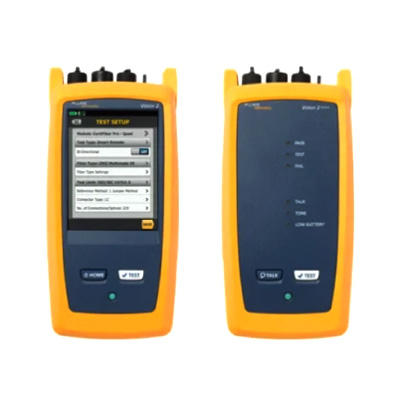
The Fluke CertiFiber® Pro Optical Loss Test Set is a professional fiber optic testing solution designed to measure optical loss and certify fiber cabling installations. When researching the Fluke CertiFiber® Pro Optical Loss Test Set Price in Bangladesh, network engineers, telecommunications professionals, and fiber optic installation contractors should consider its measurement capabilities, certification workflow, and suitability for modern optical networks. This instrument helps technicians verify whether installed fiber links meet the requirements of applicable industry standards by measuring optical power loss across the connection. It supports structured fiber optic testing for enterprise networks, data centers, telecommunications infrastructure, and commercial installations where dependable optical connectivity is essential. Its integrated testing approach helps simplify certification tasks, improve consistency, and provide documented results for installation acceptance and maintenance.
Optical loss measurement is essential for evaluating the performance of a fiber optic link. The Fluke CertiFiber Pro helps technicians measure the amount of optical signal lost as light travels through a fiber connection. Excessive loss can affect transmission reliability, reduce available optical power margins, and contribute to network performance problems. By measuring insertion loss and comparing the results with selected test limits, technicians can determine whether a link meets its specified requirements. The system supports testing at applicable optical wavelengths, depending on the installed modules and selected configuration. Accurate reference setting, appropriate test cords, clean connectors, and correct testing procedures are important for obtaining reliable results. These capabilities make the instrument suitable for professional fiber optic certification and troubleshooting workflows.
The Fluke CertiFiber Pro platform supports fiber optic certification for multimode and singlemode cabling when configured with compatible test modules. Multimode fiber is commonly used in enterprise networks and data centers, while singlemode fiber is widely deployed in telecommunications and longer-distance optical infrastructure. The appropriate test modules and wavelengths depend on the fiber type and certification requirements.
By supporting these different fiber environments, the CertiFiber Pro helps contractors and network technicians verify optical link performance across a range of installations. Selecting the correct fiber type, reference method, connector configuration, and test limit is essential to ensure that measurements accurately represent the installed link. Users should confirm the capabilities of the specific instrument configuration before beginning certification work.
Fiber certification projects can involve many links that must be tested, documented, and reviewed before a network is accepted. The Fluke CertiFiber Pro is designed to streamline these activities through guided test procedures and organized result management. Its workflow helps technicians configure tests, perform measurements, and review pass or fail outcomes without relying entirely on manual calculations.
A consistent testing process can reduce repetitive work and improve productivity on large installations. This is particularly beneficial for contractors working on data centers, commercial buildings, enterprise campuses, and telecommunications projects. Proper setup and consistent reference procedures remain essential, as testing efficiency must not come at the expense of measurement accuracy.
Optical loss is an important factor in determining whether a fiber link can operate within the available power budget. The Fluke CertiFiber Pro helps technicians measure link loss and assess whether the installed cabling satisfies the selected certification limits. These measurements can reveal problems associated with connectors, splices, fiber damage, or installation practices that introduce excessive attenuation.
When a link fails certification, technicians can use the recorded results to investigate the problem and determine whether cleaning, reconnection, repair, or further testing is necessary. The instrument supports link performance verification, but it does not replace every specialized diagnostic tool. Applications requiring precise fault-distance analysis or detailed inspection of internal fiber events may require an optical time-domain reflectometer or other complementary equipment.
Accurate documentation is an important part of professional fiber optic installation. The Fluke CertiFiber Pro supports organized storage and reporting of test results through compatible Fluke Networks software and project management tools. Technicians can maintain records of tested links, review certification outcomes, and prepare documentation for customer handover.
Well-organized test records help project managers verify completed work and provide a reference for future troubleshooting. They can also support quality assurance procedures by demonstrating whether installed links passed the selected test requirements. Correct cable identifiers, project information, test limits, and reference settings are important for producing useful reports. Maintaining these records can improve traceability throughout the operational life of a fiber optic network.
The Fluke CertiFiber Pro Optical Loss Test Set is suitable for professional environments where fiber optic cabling must be verified against defined performance requirements.
Common applications include:
These applications make the instrument relevant to fiber optic contractors, telecommunications engineers, data center technicians, and network infrastructure teams. The correct modules and test configuration should be selected according to the installation and applicable standards.
Fiber testing equipment must provide consistent measurements while remaining practical for field technicians. The Fluke CertiFiber Pro is designed to support guided testing and clear presentation of certification results, helping users follow established procedures in different working environments. Its workflow-oriented approach can simplify repetitive testing tasks and help technicians review results efficiently.
For reliable operation, users should inspect test cords and connectors, clean fiber end faces using appropriate tools, maintain correct reference settings, and follow the manufacturer's operating instructions. Fiber optic connectors are sensitive to contamination, so proper cleaning and inspection are essential before connecting test equipment. Routine maintenance and appropriate storage also help protect the instrument and its accessories during regular field use.
Selecting the appropriate optical loss test set requires an understanding of the fiber infrastructure and the certification requirements. Buyers should consider whether their projects involve multimode or singlemode fiber, the optical wavelengths required, connector types, reference methods, and applicable industry standards. Compatibility with existing test accessories and reporting software may also influence the selection.
Different configurations can offer different testing capabilities, so users should confirm the specifications of the exact model and supplied modules. It is also important to distinguish optical loss certification from optical time-domain reflectometry and optical fiber inspection, as these functions address different aspects of fiber testing. Choosing a configuration that matches the intended application helps ensure that the instrument provides the measurements required for professional network acceptance.
Businesses searching for the Fluke CertiFiber® Pro Optical Loss Test Set in Bangladesh should evaluate product authenticity, supplier reliability, warranty coverage, technical assistance, and the availability of compatible accessories. Fiber certification instruments are specialized tools, and the correct configuration is important for obtaining meaningful test results.
Before purchasing, confirm the included modules, supported fiber types, connector adapters, reference accessories, software compatibility, and warranty terms. Buyers should also verify whether the instrument meets the certification standards specified for their projects. Purchasing through a reputable testing equipment supplier can help ensure access to accurate product documentation and appropriate after-sales support.
Fluke Networks develops testing solutions for copper and fiber optic network installation, certification, and troubleshooting. Genuine equipment helps professionals work with the manufacturer's documented specifications and supported testing procedures. For the CertiFiber Pro, selecting the correct configuration and compatible accessories is especially important because the accuracy and relevance of certification results depend on appropriate setup.
Network contractors, telecommunications companies, data center operators, and enterprise IT teams should choose equipment that meets their technical requirements. Following recommended reference procedures, maintaining clean connectors, and keeping test records organized can help improve measurement consistency and support dependable project outcomes.
The Fluke CertiFiber® Pro Optical Loss Test Set offers a professional solution for measuring optical loss and certifying fiber optic cabling installations. Its guided workflow, measurement capabilities, and test documentation support help technicians verify link performance and identify installation issues. These functions are valuable in environments where reliable optical connectivity and documented installation quality are essential.
For fiber optic engineers, telecommunications contractors, network installers, and data center professionals in Bangladesh, the CertiFiber Pro is worth considering for structured fiber certification projects. Confirming the exact model, compatible modules, supported test limits, and warranty arrangements before purchasing helps ensure that the selected instrument meets the technical requirements of the intended application.
Unique Features:
Standards:
Performance:
| Specification | Details |
|---|---|
| Input Connector | Interchangeable connector adapter (LC standard, SC, ST and FC optional) |
| Detector Type | InGaAs |
| Wavelengths | 850 nm, 1300 nm, 1310 nm, 1550 nm |
| Power Measurement Range | 0 dBm to -65 dBm (850 nm), 0 dBm to -70 dBm (all other wavelengths) |
| Power Measurement Uncertainty | < ± 5% ± 32 pW |
| Measurement Linearity | < ± 0.1 dB |
| Re-calibration Period | 1 year |
| Integrated Wi-Fi | Meets IEEE 802.11 a/b/g/n; dual band (2.4 GHz and 5 GHz) |
| Notes | 1. ± 100 pW at 850 nm 2. Conditions: Power level 100 μW (-10 dBm), CW, ambient temperature 23°C ± 1°C, SC/UPC connector, 5 min warm-up, NIST traceable. 3. Linearity: -3 dBm to -55 dBm at 850 nm & 1310 nm under 23°C ± 1°C and 5 min warm-up |
Loss/Length Specifications
| Specification | CertiFiber Pro Multimode Modules | CertiFiber Pro Singlemode Modules |
|---|---|---|
| Testing Speeds | Smart Remote: < 3 sec Far End Source: ≤ 2 sec Loopback: ≤ 2 sec |
Smart Remote: < 3 sec Far End Source: ≤ 2 sec Loopback: ≤ 2 sec |
| Input/Output Connectors | Interchangeable connector adapter (LC standard, SC, ST, FC optional) | Interchangeable connector adapter (LC standard, SC, ST, FC optional) |
| Launch Condition | Encircled Flux compliant to TIA-526-14-B, ISO/IEC 14763-3, IEC 61280-4-1 | Encircled Flux compliant to TIA-526-14-B, ISO/IEC 14763-3, IEC 61280-4-1 |
| Fiber Types Tested | 50/125 µm or 62.5/125 µm | Singlemode |
| Source Type and Wavelengths | LED source: 850 nm ± 30 nm 1300 nm ± 20 nm |
Fabry-Perot laser diode: 1310 nm ± 20 nm 1550 nm ± 30 nm |
| Maximum Length Measurement | 12 km | 130 km |
| Length Measurement Accuracy | ± 1.5 m plus ± 1% of length | ± 1.5 m plus ± 1% of length |
| Output Power (Nominal) | ≥ -24 dBm with EF-TRC | ≥ -4 dBm |
| Output Power Stability | ± 0.05 dB over 8 hours ± 0.03 dB over 15 minutes |
± 0.1 dB over 8 hours ± 0.08 dB over 15 minutes |
Loss/Length Specifications (continued)
| Specification | Details |
|---|---|
| Source Wavelengths | 850 nm, 1300 nm, 1310 nm, 1550 nm |
| Power Measurement Range | 0 dBm to -65 dBm (850 nm) 0 dBm to -70 dBm (all other wavelengths) |
| Power Measurement Uncertainty¹² | < ± 5% ± 32 pW |
| Measurement Linearity³ | < ± 0.1 dB |
| Re-calibration Period | 1 year |
Footnotes:
±100 pW at 850 nm
Under the following conditions:
• Power level: 100 μW (-10 dBm), continuous wave (CW)
• Wavelengths: 850 nm and 1310 nm
• Beam: Divergent, NA = 0.20 for 50/125 μm and NA = 0.14 for 9/125 μm
• Temperature: 23° ± 1°C
• Connector: SC/UPC with ceramic ferrule
• Warm-up time: After 5 minutes
• Calibration: Traceable to NIST
Range: -3 dBm to -55 dBm at 850 nm and 1310 nm
• Temperature: 23° ± 1°C
• Warm-up time: After 5 minutes
| Title | Requirement |
|---|---|
| Output Power | >-5 dBm <0 dBm SMF-28 singlemode fiber Continuous wave SC/UPC connector |
| Operating Wavelength | 650 nm nominal |
| Output Modes | Continuous wave Pulsed mode (2 Hz to 3 Hz blink frequency) |
| Connector Adapter | 2.5 mm universal |
| Laser Safety | Class II CDRH Over operating temperature range |
| Title | Requirement |
|---|---|
| Operating Temperature | -10° C to 45° C |
| Storage Temperature | -10° C to +60° C |
| Operating Relative Humidity | 0 % to 90 %, 32 °F to 95 °F (0° C to 35° C) 0 % to 70 %, 95 °F to 113 °F (35° C to 45° C) |
| Vibration | Random, 2 g, 5 Hz-500 Hz |
| Shock | 1 m drop test with and without module and adapters |
| Safety | CSA C22.2 No. 1010.1: 1992 EN 61010-1 1st Edition + Amendments 1, 2 |
| Pollution Degree | 2 |
| Altitude | Operating: 4,000 m Storage: 12,000 m |
| EMC | EN 61326–1 |
N/A
No resources available for this product.
No reviews yet. Be the first to review this product!
Related Products
Discover your related products for more professional testing and measurement solutions.


