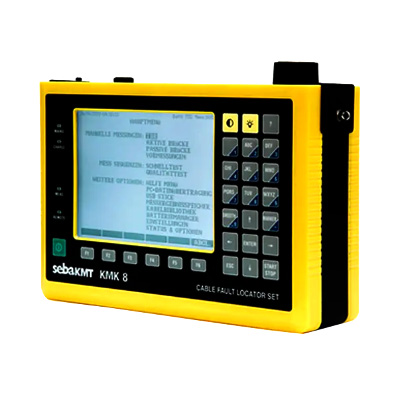
Megger MTDR300 3 Phase TDR
Simplify Three Phase Cable Testing with Reliable TDR Technology


The Megger MTDR300 three phase time domain reflectometer is designed for professionals who need to investigate cable faults and assess cable conditions efficiently. When researching Megger MTDR300 3 phase TDR Price in Bangladesh, electrical engineers, utility technicians, and industrial maintenance teams should consider the instrument's intended application, supported cable types, and testing requirements. Time domain reflectometry works by sending an electrical pulse through a cable and analysing the reflected signal to identify impedance changes. This technique can help locate discontinuities and investigate certain cable faults, supporting more systematic troubleshooting and maintenance.
The MTDR300 has been discontinued and is being replaced by the Teleflex SX-1:
Three phase electrical systems rely on multiple conductors to distribute power to equipment, industrial facilities, and utility networks. When cable faults occur, technicians may need to investigate individual conductors and compare test results to determine the affected section. A suitable three phase time domain reflectometer can support cable fault investigation by helping users examine signal reflections and estimate the distance to a discontinuity. Actual capabilities depend on the instrument's design and specifications. Users should verify the manufacturer's documentation to confirm the supported testing configuration and whether the instrument is appropriate for their specific three phase cable application.
Time domain reflectometry is a diagnostic method used to investigate electrical cable characteristics. The instrument transmits a pulse along a cable and measures the reflections caused by changes in impedance. These reflections may indicate cable ends, joints, connectors, damaged sections, or other discontinuities. By interpreting the waveform and applying the correct cable velocity factor, a technician can estimate the distance to a suspected fault. The reliability of the result depends on cable construction, impedance characteristics, test settings, and the nature of the defect. High-resistance or intermittent faults may require additional testing methods to establish the actual fault location.
Cable fault location is an important part of electrical maintenance because faults can interrupt operations and require time-consuming investigation. A TDR instrument helps narrow the search area by providing information about signal reflections along the cable. Technicians can use the displayed waveform to investigate discontinuities and compare results across accessible conductors when the instrument supports the required configuration. Correct interpretation requires knowledge of cable characteristics and measurement limitations. A waveform change does not automatically confirm insulation failure, so users should evaluate the results alongside cable records, visual inspection, and other suitable electrical tests.
A three phase TDR instrument may support maintenance activities involving compatible power cables in factories, commercial buildings, utility installations, and infrastructure projects. Electrical contractors can use suitable cable testing equipment during troubleshooting and repair work, while maintenance teams may incorporate reflectometry into cable inspection procedures. Power distribution personnel can also benefit from structured fault investigation when compatible cables develop discontinuities. Before using the Megger MTDR300 for a particular system, verify its rated application, cable compatibility, and operating requirements. Not all reflectometers are suitable for every cable type or voltage class, and specialist power cable faults may require dedicated high-voltage fault-location equipment.
Using a suitable time domain reflectometer can make cable fault investigations more organised and efficient. By estimating the distance to a suspected discontinuity, the instrument may help technicians focus their inspection efforts on a more relevant section of cable. This can reduce unnecessary troubleshooting and support better repair planning. Consistent test procedures can also help maintenance teams document findings, compare results, and develop a clearer history of recurring cable problems. These benefits depend on proper instrument selection, correct testing practices, and the user's ability to interpret the results. A TDR supports diagnosis; it does not repair a cable or guarantee an exact fault location in every situation.
When evaluating the Megger MTDR300 3 phase TDR Price in Bangladesh, buyers should begin by identifying the type of cable network and the faults they need to investigate. Important considerations include cable construction, conductor arrangement, expected cable length, fault characteristics, measurement requirements, and the working environment. It is also important to check the instrument's supported testing modes, display functions, accessories, power requirements, and operating instructions. If the intended application involves medium-voltage or high-voltage power cables, confirm whether the instrument alone is sufficient or whether additional equipment and testing methods are necessary. Reviewing these factors helps ensure the selected instrument is appropriate for the actual task.
Professional electrical testing instruments should be purchased with clear product identification and technical documentation. Buyers should confirm the manufacturer's name, exact model designation, specifications, user manual, and included accessories. The product documentation should establish the instrument's intended applications, supported cable types, operating conditions, and limitations. Where applicable, request information about conformity documentation, calibration, verification, and servicing. It is also advisable to confirm warranty coverage and the availability of replacement components. Checking these details before purchasing helps reduce the risk of selecting equipment that does not meet the requirements of the intended cable testing application.
Cable testing must be performed with appropriate precautions. Before connecting a TDR instrument, users should identify the cable, understand the circuit arrangement, and follow the manufacturer's instructions. The cable must be isolated from hazardous sources and verified safe where required. Do not connect the instrument to an energized circuit unless the equipment is explicitly rated and approved for that use. For three phase systems, technicians should consider connected equipment, parallel conductors, terminations, and other circuit conditions that may affect measurements. Medium-voltage and high-voltage cable testing should be planned and carried out by appropriately qualified personnel using suitable equipment and established safety procedures.
Technical assistance can help
Advance Engineering Solutions provides engineering test and measurement equipment for businesses and technical professionals in Bangladesh. Customers interested in the Megger MTDR300 three phase time domain reflectometer can visit enquire about product availability, technical documentation, and ordering requirements. When making an enquiry, describe the cable type, testing objective, and intended working environment so the appropriate product information can be reviewed. Before confirming an order, verify the exact model, included accessories, warranty terms, delivery arrangements, and available technical support. Selecting a suitable TDR instrument helps support organised cable fault investigation and dependable electrical maintenance.
After identifying the cable fault type, the appropriate fault prelocation method can be selected.
Rule of Thumb
Fault resistance below approximately 300 Ω: Low-voltage (LV) fault location
Fault resistance above approximately 300 Ω: High-voltage (HV) fault location
Time Domain Reflectometry (TDR), also known as pulse-echo testing, is used to prelocate low-resistance faults in cable networks.
The MTDR300 supports three-phase operation, allowing simultaneous comparison of up to three phases. This helps identify the faulted phase and compare phase characteristics.
Arc Reflection
Arc reflection is a widely used method for high-voltage cable fault prelocation. A temporary bridge to earth stabilizes the fault while a pulse-echo measurement is taken. The resulting trace is compared with a previously recorded low-voltage trace, and the point of divergence indicates the fault location.
Arc Reflection Plus (ARP)
The MTDR300 can display up to 1,024 traces during a single arc, depending on the range. This helps overcome misleading traces that may occur while the arc is unstable.
Differential Arc Reflection (DART)
DART removes unwanted common reflections to produce a clearer trace showing the fault location. It is particularly suitable for complex cable networks containing multiple joints, splices, or connected equipment.
Impulse Current (ICE)
Impulse Current is a transient fault prelocation technique suitable for high-resistance faults. A linear coupler or current transformer integrated into the impulse generator detects transient signals produced by a fault flashover. The MTDR300 displays these signals and functions as a storage oscilloscope.
Voltage Decay
Voltage decay is similar to the impulse current method, but the cable is charged using a DC source to create the flashover. A voltage divider detects the resulting signals, which are displayed on the MTDR300 operating as a storage oscilloscope.
|
Specification |
Details |
|---|---|
|
Modes |
Three-phase pulse echo, Arc reflection, Arc reflection plus (ARP), Differential arc reflection (DART), Impulse current (ICE), Voltage decay |
|
Range |
Automatic and 10 selectable ranges |
|
TDR Range |
100 m to 55 km (328 ft to 34 miles) |
|
Transient Range |
100 m to 220 km (328 ft to 137 miles) |
|
Output Pulse Width |
Automatic, depending on range; 50 ns, 100 ns, 200 ns, 500 ns, 1 μs, 2 μs, 5 μs, 10 μs |
|
Output Pulse Amplitude |
25 V into 50 Ω |
|
Sampling Rate |
100 MHz |
|
Timebase Accuracy |
200 ppm |
|
Resolution |
0.82 m (2.7 ft) at a propagation velocity of 55% |
|
Display |
10.4-inch (26.4 cm) full XGA color display |
|
Display Resolution |
1024 × 768 pixels |
|
Cursors |
Dual cursors with independent control |
|
Gain |
60 dB range in 5 dB steps |
|
Input Impedance |
50 Ω |
|
Ports |
3 × TDR, 1 × arc reflection/transient methods, 1 × USB |
|
Software |
CAS-1 cable analysis software |
|
Main Power Supply |
100–240 VAC, 45–65 Hz |
|
Battery |
14.4 V NiMH |
|
Operating Time |
Approximately 2 hours on a full charge |
|
Recharge Time |
Approximately 2 hours |
|
Dimensions (mm) |
305 × 194 × 360 mm |
|
Dimensions (inches) |
12 × 7.6 × 14.2 inches |
|
Weight |
6.7 kg (14.7 lb) |
|
Operating Temperature |
−20°C to +50°C (−4°F to +122°F) |
|
Humidity |
Below 95%, non-condensing |
No resources available for this product.
No reviews yet. Be the first to review this product!
Related Products
Discover your related products for more professional testing and measurement solutions.